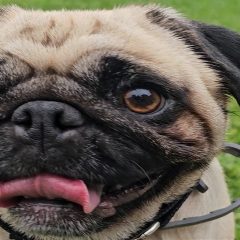
Glaucoma in dogs: natural home remedies

“Eyes are the reflection of the soul”.
I don’t know about you, but when I look deep into my dog’s eyes, I see him thinking, analyzing and understanding what I’m telling him.
Glaucoma is an eye disease that dogs can suffer from. It results from an increase in intraocular pressure and is a very painful condition, which can lead to complications such as loss of sight.
Does this disease remind you of something? This is likely because humans can get glaucoma too. That said, glaucoma in animals is generally more painful, as the pressure in the eye tends to rise to higher levels than in humans!
Does your dog have glaucoma and are you worried about seeing them in pain, about seeing their quality of life deteriorate? In this article, we present natural solutions, a gentle holistic approach to help you support your pet and offer them a better quality of life.
Cat owners have been told not to say the letter “s” to their cats because it has been compared to “swearing” at them.
Cat owners should stop saying “Here, puss” to moggies because it is “like swearing at them”.
A pet charity says words with “s” in them sound like aggressive hissing.
PDSA vet nurse Gemma Renwick added: “Cats pick up on certain sounds and tend to prefer fewer ‘s’ sounds. The ‘s’ noise is similar to a cat hissing, which is almost like swearing at them every time you want their attention.

“Consider speaking their language and meowing at them.
“Unlike hissing, adult cats don’t really meow at one another, but do use meows to communicate with us humans.”
Gemma warned feline fans of several moggy mistakes ahead of next Tuesday’s annual #HugYourCatDay — including cuddles.
She said: “Hugging, and other approaches we may consider signs of affection, can actually be detrimental.
“If a cat runs away as you come towards them or they dash off as soon as you let go, it’s a good sign they don’t want to be touched or have their personal space invaded.
“Always let your cat come to you and you’ll reap the rewards of consensual kitty cuddles.”
Gemma added that making eye contact was “quite threatening” and advised we instead copy cats’ “slow blink”.
And playing with laser pointers leaves empty-pawed cats frustrated.
Gemma also warned against using citrus-smelling cleaning products on litter trays which “could actually put them off using it”.
Wild baby critters are beyond adorable, and might seem helpless, but experts provide important tips for assessing the situation and handling it properly.

Spotting a baby animal in the wild immediately sparks a sense of wonder at their innocence and, let’s face it, all the other heart-led feels. So when we stumble upon a sweet creature that seems to be without a family, naturally we want to rush in and help.
An abandoned baby animal might, in fact, not be alone at all. Lynn Cuny is the founder and president of Wildlife Rescue & Rehabilitation in San Antonio, Texas. If you found a wild animal nestled in the brush during your morning jog, it’s likely that the baby’s mama is nearby.
“In the vast majority of cases, if a human comes near a nest of babies, the mother will flee,” she says. “For example, anyone seeing a fawn sleeping under a tree, in a backyard, or anywhere may wrongly assume that she has been abandoned. What has happened is that the mother deer has fled when the people approached.” Cuny recommends that if you spot a baby wild animal, it’s best to leave them alone, assured they’re being cared for by their parents.
It’s essential to help our pets understand this message as well. Some dogs are bred as hunting companions, and cats have a natural predatory instinct. But in many circumstances, you can teach a dog through positive reinforcement training not to be so reactionary to other creatures around him, and the National Wildlife Federation recommends methods to help reduce cat and wildlife interactions.
“A baby bird, squirrel, or rabbit will often die once she has been bitten by a dog or cat,” Cuny says. “Keep dogs on a leash if they are in an area where wildlife live, and keep cats indoors so they cannot find and harm helpless birds, lizards, squirrels, and other wildlife.”
When to Help a Baby Animal
Are there times when humans should help baby wildlife? Yes, to a point. Let’s say you found a baby bird that fell out of its nest, or a baby squirrel that seems too young to scamper about. Cuny suggests making it easier for wild parents to find their lost critters by containing them.
“If you happen to see a baby bird or squirrel out of her nest, due to a storm or the cutting down of a tree, it is best to create a makeshift nest,” she says. “Use a small box with some soft bedding that you can secure up in a nearby tree and place the baby in the box to see if her parents will return to care for her.”
Often, a quick call to your state’s fish and wildlife organization or county animal assistance office will provide you with the proper steps to assist a particular creature. Then, you can simply keep an eye out for the grand reunion.
We’ve all heard that you shouldn’t handle baby wildlife with your bare hands, otherwise they’ll be rejected by their mothers. Cuny says this simply isn’t true. “Wild parents will not abandon their babies because they have been touched by a human. This is an old, false tale and needs to be dispelled.”
Elizabeth Manning of the Alaska Department of Fish and Game offered more details in her article on the department’s website. “This is essentially a myth, but one that no doubt started to help prevent people from disturbing wildlife,” she writes. Most bird species, for example, can’t smell well. And the majority of mammals accept the return of their babies without issue.
“Baby animals that have been handled by biologists are usually reunited with their mothers, who do not appear bothered by the biologists’ scent on their young,” Manning says. “Again, disturbance is the real problem.”
If you’ve found a baby bunny, a wild bird, or another wee creature who might need help, create a temporary shelter or nest with gentle, minimal movements so as to not frighten the creature any more than she probably is. Wearing gloves is often a good idea to avoid bites and scratches, and to prevent the spread of potential diseases. But if you don’t have time to grab a pair, just make sure to wash your hands thoroughly before and after handling an animal.
What to Do With an Injured Wild Baby Animal
There are times when you might find an injured baby animal, such as after a car accident or an encounter with a larger natural predator. Cuny recommends bringing in professionals.
“If you see any wild animal who you think is injured, call a local, licensed rehabilitator and have them provide assistance to the animal,” she says. “You can also contact your state wildlife agency for information on how to locate a rehabilitator.”
When might a baby wild animal need professional help? The Humane Society of the United States points to the following signs:
- Your pet brings a wild animal to you.
- The creature is shivering, bleeding, or has a broken limb.
- A bird is on the ground featherless or nearly featherless.
- The baby animal is crying and wandering around most of the day.
- You spot a dead parent nearby.
Review the Humane Society’s checklist of best practices if you’ve found a baby wild animal or bird, which includes specific tips for baby deer, foxes, possums, rabbits, skunks, and squirrels. You’ll also learn how to handle the creatures and, if necessary, suggestions for calm transport.
